
Lessons From a Sports Commentator Laser-Focused on the Loser
How unconscious bias can create narratives that don't tell the whole story

There’s a phrase I’ve used through the years during my conversations on the subject of race. The phrase is “the mechanisms of white supremacy.” I started using this expression to describe a category of consistent cognizable patterns that emerge where white supremacy operates. These patterns are repeated across all categories of bias, and they often show up in the same ways in different contexts. I initially believed that educating people about these patterns would help reduce bias in all the ways it manifests.
Eventually, I realized that this phrase and my descriptions of those mechanisms are of little interest to most people. I found that’s not the case, however, for stories about the mechanisms of bias in action, whether the listener understands the underlying patterns or not. Those discussions have proven much more impactful and productive. I bring you one such a story today.
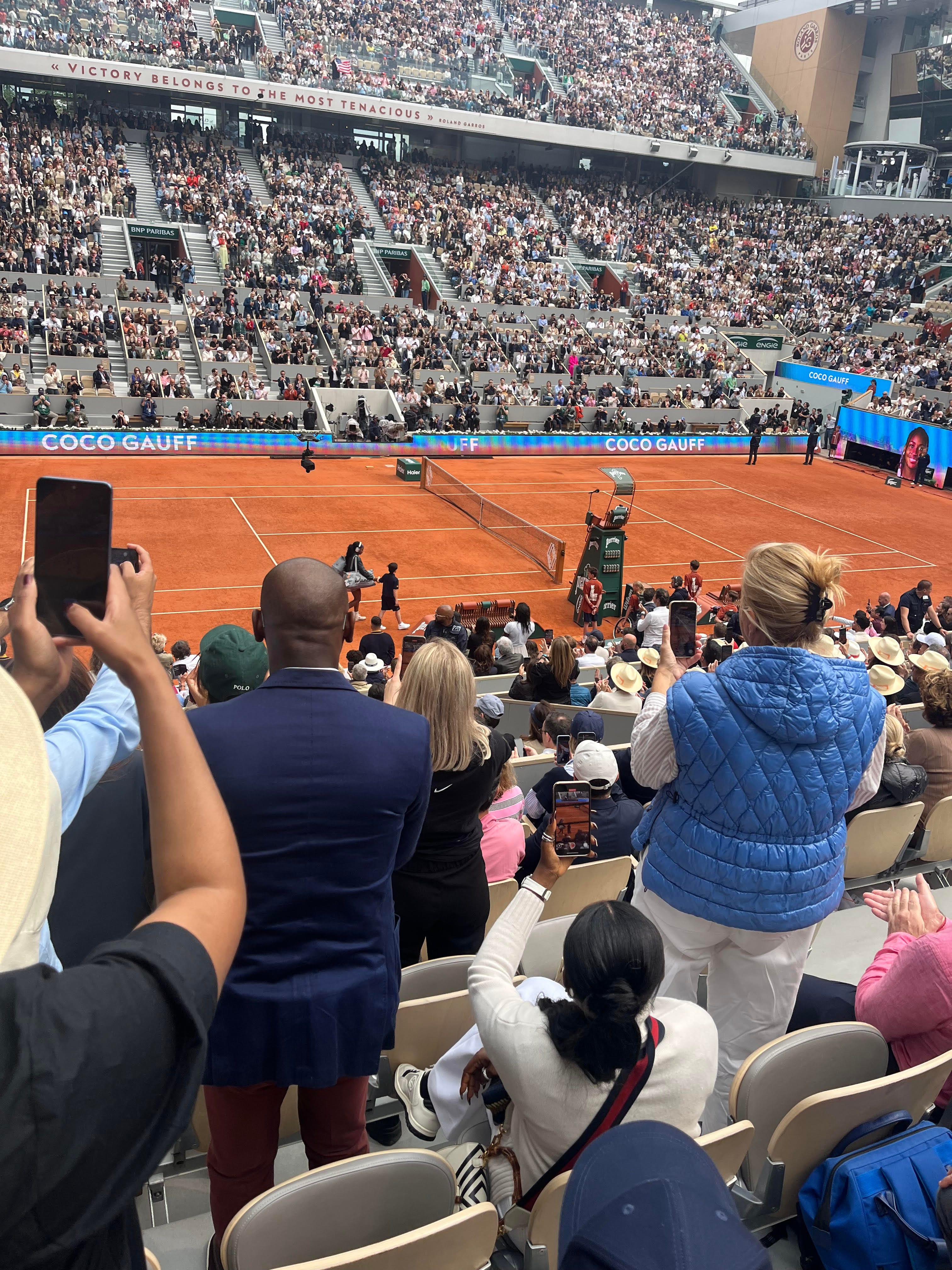
First, I should give you some background. I’m an avid tennis fan. So is my partner. We watch tennis highlights regularly. We follow the ATP and WTA tours closely. We track players’ tactics, injuries, and perspectives. We watch interviews and individual player YouTube channels. We even had near-court seats for the French Open this year where Coco Gauff defeated Aryna Sabalenka in an epic final match (the feature photo for this article shows our seats).
One of my favorite players on the WTA tour is Taylor Townsend. While many might recognize her from her recent post-match encounter with Ostapenko that triggered conversations about racism in tennis, I have admired her game and fortitude for many years. Reading Townsend's words about her tennis story, her arduous work on herself and her career, and her hard-fought triumphs made me a forever fan. Currently, she has matched her best result at the US Open, one of the four annual major tennis tournaments.
After the very recent and still active media storm that occurred surrounding Ostapenko telling Townsend she has “no class” and “no education,” I was worried that’s all anyone would talk about. Oftentimes people get hung up on the attacker. But I was pleased to see that Townsend handled this event with incredible poise, wisdom, and skill. Don’t take my word for it. Check out her full post-match interview and decide for yourself. Luckily, it turns out that Townsend winning her subsequent match against a top ten player was bigger news than her previous opponent’s post-match tantrum.
And here is where my story begins. Sometimes it’s convenient for me to follow a tennis match live without actually watching the video feed. In 2025 there’s a YouTube channel for that. Cam Williams is a tennis commentator and content creator I’ve been following for years to track live matches. His channel is “Tennis Talk,” and I find him very knowledgeable about the players in both the ATP and the WTA.
I was watching Cam’s livestream of Townsend’s match against world number five Mirra Andreeva late into the night. It was always going to be a tough match for the one hundred thirty-ninth ranked Townsend, but she came in with a game plan, superior experience, a supreme level of belief, and a hometown crowd eager to celebrate her victory. They got their chance. Cam narrated Taylor’s winning points and pronounced her the winner of the match.
I immediately ran downstairs to break the news to my partner. We shared the excitement of this big-time win and our joy for Taylor’s success for about ninety seconds before I returned to the livestream. It was about time for me to head to sleep, but I didn’t shut down the stream yet. I waited for what I thought would be a short moment. I waited to hear Cam’s commentary, commentary that I’ve enjoyed for years, focus on Taylor’s excellent play that won her the match.
At first I thought I missed it. I waited. And I waited. And I waited. Over twenty minutes of post-match commentary passed, and Cam uttered not a single word in praise of Townsend’s gameplay. I had no initial intention of waiting for that long. I expected what almost always happens would happen. The winner of the match would receive credit for her play. Even in tennis matches where other factors have an influence in the outcome, even a significant influence, I’ve never heard Cam completely abstain from attributing a tennis player’s game, execution, and/or strategy to their win.
Yet that’s exactly what happened. His post-match commentary was focused entirely on the loser of the match, Mirra Andreeva. He commented about this being the second time Andreeva has allowed the crowd to impact her play in a major tournament. But more than that he offered this narrative as the sole story of the match. From listening to his commentary, you would think Andreeva was only playing herself, and Townsend was simply waiting in the wings to see whether Andreeva would allow her to win by beating herself.
I honestly couldn’t believe it. I’d never heard Cam give zero credit to the play-making of a match winner under any circumstances, but it was happening before my eyes. He was laser focused on Andreeva’s loss rather than Townsend’s win. “[She] let the crowd get to her in the first set and couldn’t recover in the second,” Cam opined. He empathized with Andreeva, and he encouraged the chatters to have empathy for Andreeva’s struggle as well. He talked about how she did not play well in the big moments. And he consistently described Andreeva’s inexperience and the U.S. crowd’s influence as the sole determinants of the match’s outcome.
As Cam was crafting this one-sided narrative, I began composing and sending chat messages expressing my disappointment in his choice to remove Townsend’s excellent play from the equation. The silence on her stats, strategy, and execution on one of tennis’s biggest stages was impossible for me to ignore. Cam consistently reads and references comments in the chat log, so I figured he would read my chats and eventually acknowledge Townsend’s play. He did not. He read comments before mine and after mine, but he did not once laud Townsend for how she achieved this win. Rather, he spent the entire twenty plus minutes talking about the loser of the match and emphasizing the influence of the crowd on the match’s outcome.
I might have been the first person to recognize and highlight Cam’s lack of acknowledgement of the match winner, but I wasn’t the only one. After three comments regarding his decision not to comment on Townsend’s play, history, or fortitude in securing the win, another chatter tagged me. They saw what I saw, and they wrote a chat to that effect. From that point on as Cam continued his narrative about Andreeva, more and more chatters started noticing and responding to what I first pointed out.
“Townsend played a great match!”
“Yay Taylor!”
“Great work, Taylor! You earned it.”
More and more messages congratulating Townsend on her win and acknowledging her for her play began populating the chat where none existed before my initial message (that’s not an exaggeration). It still did not change Cam’s commentary. He continued reading comments and responding, but he did not once adjust the narrative to focus on the winner of the match. The entire story for him was that Andreeva lost the match because of her inexperience and mental weakness in dealing with the crowd. Townsend’s play never arose as a contributing factor in her victory. I even rewatched the entire post-match commentary multiple times to make sure I didn’t miss anything.
Cam compounded this oversight by mentally erasing two of Townsend’s greatest accomplishments as a tennis professional, winning both Wimbledon and Australian Open doubles titles. He was making a comment about Andreeva losing the match that implied Townsend never won a major tournament championship and realized mid-sentence that wasn’t accurate. Townsend won a Wimbledon double’s title just last year and the Australian Open (Cam’s home major tournament) this year. Instead of acknowledging that fact, he changed his declaration to indicate Townsend has not won a major singles title.
Cam also ignored the accomplishment of Townsend’s next opponent Barbara Krejcikova. “Now Townsend is playing Krejcikova. Huh? One of them is making the quarterfinals. Who would have thought that?” Perhaps someone who knew and was willing to acknowledge that Krejcikova has reached the quarterfinals of the US Open in the past would. Perhaps someone who recognizes her as a two-time major tournament singles champion and three-time quarterfinalist would. Perhaps someone who has perceived that Townsend has steadily improved her singles game along with her doubles game and is at the peak of her career would.
I believe what happened at the end of this livestream is a clear expression of unconscious bias. Cam acknowledged Townsend as the current number one doubles player in the WTA. When asked to choose a victor for Townsend’s next match, he chose Townsend to continue winning (although in context it seems he was attributing that future win largely if not entirely to the crowd as well). I don’t think he has any conscious animus towards Townsend at all. That’s what makes the bias unconscious and why I chose to bring it into his conscious perception. Unfortunately, my attempt to get Cam to acknowledge Townsend for her actual play bolstered by an increasing number of chatters during the livestream failed.
There was one bright spot that I want to acknowledge. Cam educated his chatters about the gatekeeping tennis is known for (without directly implicating race, naturally) and encouraged the acceptance of new players, fans, and behaviors within the sport. He even took the time to show one chatter a blind spot regarding how a partisan tennis crowd cheers for their hometown favorite when one chatter suggested we’ll see “fighting in the stands next.” Cam rightfully called that line of thinking silly. “If you go to France and you play someone from France, it’s going to be a tough day, right? That’s normal. We know that….Its happened for decades.”
It was ironic that Cam rightfully called out the silliness of chatters’ comments about the rowdiness of the crowd while walking far off the beaten path himself. A long-time tennis commentator virtually always spends some time acknowledging the play of the winner of the match. It’s as standard as the post-match handshake, not just in tennis but in all sports. Winning dictates at least a portion of the narrative no matter how the loser performed. That’s what made this commentary stand out like a sore thumb.
I am confident that Cam has no clue he did not give Townsend her appropriately due credit. I will even suggest that if I showed him my perspective in this article, he would be surprised at reviewing his own commentary and apologize. I’ve witnessed enough of his character through the years to see that. Yet his character did not stop him from exhibiting bias unconsciously during a pivotal positive part of Townsend’s career.
Bias exists in all of us, and it doesn’t have to be nefarious. It can just be. And if its existence goes unrecognized by the person holding it, then that bias will impact that person’s perceptions. When we share that perspective like Cam did, the bias gets passed from one person to next like an endless chain of limitation.
The only way to deal with our biases are to confront them consciously and intentionally. It isn’t easy. It requires wrestling with our own thoughts critically and sometimes acknowledging that we erred. It requires acknowledging the development of bias as part of the human condition. And it requires the intentional limiting of that bias through purposeful action and perpetual reflection.
It may seem like a lot of work, but it is more than worth it. Limiting our biases allows us to see the world for what it really is rather than what we imagine it is. It can reveal both the beautiful and grotesques aspects of ourselves and each other. Those revelations are catalysts for human growth, something I hope we can all agree is an objective common good.
My anti-racism work is designed to promote that common good. I help people bring their biases into their conscious awareness. I teach how to use one’s chosen values to identify when one’s biases interfere with a true perception of the world. And I teach about the priceless benefits of human connection and understanding that come from choosing to intentionally limit one’s biases.
If you find that work to be valuable, please consider subscribing to my Substack for free or as a paid subscriber, sharing my work with others, and joining me in a movement to build a consistent environment where people can make a conscious choice to minimize the impact bias has on their personal perceptions and the world. Thanks for reading, and stay tuned for more content!
Will Fullwood (“Contraband”)
Great story showing how implicit biases inevitably show themselves. Nicely done.
I love Taylor! Also, Cam reacting like that to Krejcikova is crazy ... let alone his obvious bias against Townsend, what the heck?! How do we get Cam to read that piece and acknowledge what happened there??